Beyond the PTZ: The Case for 360° Continuous Awareness on the Superyacht Bridge
At shows and shipyard visits I ask captains the same question: what is the one thing your current camera setup still does not give you? Invariably, blind spots come up. The inherent weakness of any PTZ. After a little to and fro, another pain point surfaces: the inability to review something that happened outside the camera's current field of view. In a survey we ran with captains and officers across the industry, 57% cited blind spots as their biggest on-water visibility challenge, and nearly three quarters said they would value a system that lets them review a near-miss or incident after the fact.
Where the Ambition Outgrows the Tool
Most of the captains and ETOs I meet are looking to push further. Better night coverage. Less load on the watch officer. A complete record of the operating environment, not just the slice the camera happened to be pointed at when something occurred. That is a different ask, and it needs a different answer.
In our captain's survey, 52% said they would find value in a 360° day and night vision system that continuously views everything around the vessel. A further 30% said maybe. When asked about priorities, 60.9% listed a 360° view around the yacht and 43.5% listed review of archived incidents — ahead of real-time alerts and night vision view as standalone features.
The limitation of a PTZ is architectural, not optical. One camera covers one direction at a time. To monitor the full perimeter you need multiple units, active operator coordination, and crew resource that most watches cannot sustain continuously. COLREGs Rule 5 requires a proper lookout by all available means — a PTZ contributes to that, but a directed sensor is not the same as continuous awareness of the vessel's full environment.
The limitation that matters most is the absence of a record. When something happens outside the camera's current frame, that moment is gone. The PTZ was pointed elsewhere. Whatever occurred to port while the watch was focused on starboard exists only in the memory of whoever was on duty. For incident review, for insurance, for any serious post-event analysis, that gap is significant.
FROM: Reactive Viewing
3 × PTZ Cameras
Directional & Fragmented — Can't See Everything
TO: Real-Time Awareness
1× Panoblu System
Continuous 360° Situational Awareness
What Changes When the Camera Never Stops Looking
The practical difference a 360° continuous system makes on the bridge is less about what it sees and more about what it frees up. When every angle is covered simultaneously and, if required, permanently recorded, attention shifts from operating equipment to reading the environment. That is where the real value sits.
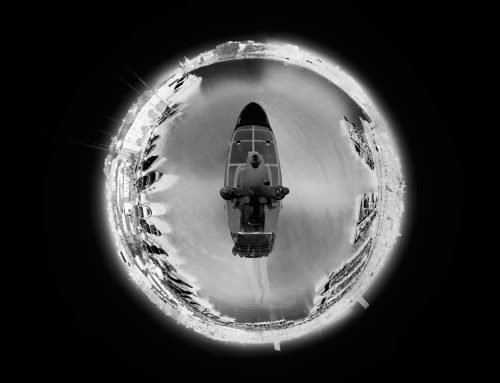
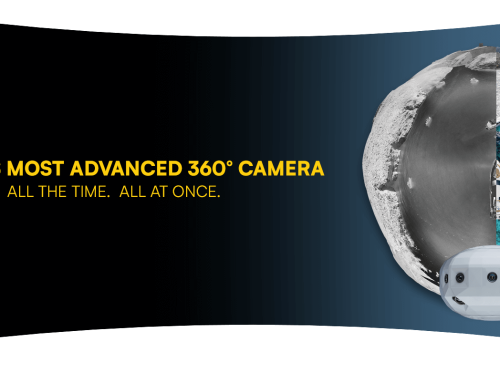
For anchor watch, for night passages in busy coastal waters, for manoeuvring in marinas where approaches can come from every direction at once, a system that requires no direction is a different category of tool. Panoblu SeaView captures continuous 360° 4K panoramic video using 12 fixed F2.8 lenses simultaneously — no mechanical pan, no operator required to point it, no moment where the vessel is unmonitored. Panoblu IR delivers the same in thermal infrared, day and night, in fog and reduced visibility where continuous coverage matters most.
The ability to permanently record comes up in conversations across the board. Not because incidents are expected, but because a complete GPS-indexed visual log of every voyage changes the conversation if one does occur. It is the same logic as a voyage data recorder, applied to the full visual environment of the vessel.
For Some, It Replaces. For Others, It Complements. Either Way, the Gap Gets Closed.
PTZ thermal cameras remain the right tool for long-range identification. At 4km in darkness with a 30x optical zoom, they show you things a wide-angle panoramic system cannot match at that range. That capability does not go away.
What 360° continuous imaging adds is the layer underneath: total perimeter awareness, always on, always recording, no operator input required to maintain it. The PTZ identifies. The panoramic system ensures that whatever the PTZ is not currently pointed at is still being recorded. Together they close the gap that captains keep describing at the stand.
- Panoblu SeaView: Continuous 360° 4K panoramic imaging, 12 fixed F2.8 lenses, no mechanical pan, GPS-indexed record. Day navigation, voyage logging, marina approaches, anchor watch.
- Panoblu IR: The same continuous 360° architecture in thermal infrared. Night passages, fog, reduced visibility, man overboard detection, perimeter surveillance at anchor.
- PTZ thermal: Long-range directed identification of a specific target. Complementary, not competitive. Both belong on a serious bridge.
Visitors to the stand are often looking for a robust, all-in-one solution: something that covers blind spots, sees in the dark, and can be left to do the job without constant operator input. Some are replacing PTZ cameras that have failed or become unreliable. Others are adding a continuous layer alongside existing equipment. The requirement is the same either way — full situational awareness, day and night, with a record of everything that happened and when.
That is what 360° continuous imaging delivers. The architecture is different. The result is a bridge that does not depend on where the camera happens to be pointing.