The Horizon is 360°: Why Total Situational Awareness is the New Standard in Yachting
In the evolution of superyacht technology, we have reached a point where "standard" is no longer synonymous with "sufficient." For decades, the industry has relied on high-end, directed thermal sensors. These systems have served us well. But growing demand from owners, captains and fleet managers is driving a fundamental shift away from directed observation toward total situational awareness, and the bridge technology that supports it is changing accordingly.
The Evolution of the "Improper Lookout"
Recent MAIB and IMO reports continue to cite "improper lookout" as a primary factor in nearly 24% of all maritime incidents. Despite having $100k+ camera arrays, vessels are still colliding with "non-cooperative targets" — kayaks, tenders, or small wooden hulls that don't carry AIS and have a negligible radar cross-section.
The failure is not the camera. It is the intermittency.
A directed sensor is only as effective as the person or program controlling it. If the camera is zoomed in at 20x magnification to identify a buoy at 4km, the vessel is effectively blind to the other 350 degrees of the horizon. That is the structural gap modern bridge design has yet to fully close.
Why 360° is the Natural Successor
Superyachts have always been the Formula 1 of the sea, testing technology that eventually reaches commercial shipping. Modern maritime operations are now looking beyond single-direction thermal toward continuous thermal panoramic awareness solutions. Three reasons are driving this:
- From Reactive to Proactive: Traditional systems require a human to manually scan with a joystick. A 360° panoramic system provides a continuous feed that never blinks.
- The Hybrid Bridge Architecture: A future-ready bridge integrates 360° panoramic imaging as the continuous detection layer, providing the global view, alongside directed sensors for identification and detail. These approaches are complementary, not competitive.
- Liability and the Zero-Trust Standard: Insurance providers are beginning to recognise total awareness systems as a foundation for improved risk assessment and potential premium reduction. A recorded 360° log of an entire night watch provides a continuous operational record, supporting incident review, situational reconstruction, and greater transparency when events need to be assessed. The record becomes a source of clarity and protection.
Cutting Through Innovation Fatigue
There is comfort in the safe hands of legacy brands. But relying solely on familiar systems can lead to bridges accumulating redundant monitors and siloed data feeds that become increasingly difficult to manage efficiently in demanding conditions.
The true value of a 360° yacht camera system is not simply more pixels, it is improved situational awareness with less operational friction. A well-designed panoramic system helps crews maintain a continuous understanding of the environment, highlighting a thermal signature 2km ahead before a disturbance on the water is easily visible to the naked eye.
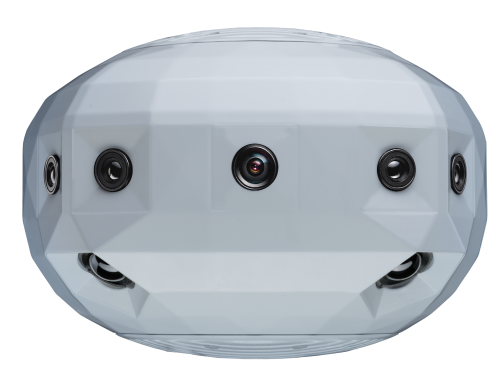
Unlike PTZ cameras, Panoblu SeaView and Panoblu IR require no mechanical pan and capture the full 360° field simultaneously. There is no motor to maintain, no direction to choose, and no moment where the vessel is blind to one side while monitoring the other.
Progression Over Comfort
The maritime industry often holds to what it knows because what it knows is "safe." But true safety is found in progression. The move toward full-perimeter awareness is the natural successor to the manual spotlight and the joystick-controlled camera.
As yacht designs become more ambitious and the global fleet grows, the conversation is shifting from whether panoramic awareness systems have a place on the bridge to how they can be integrated effectively alongside existing navigation and detection tools.
Bridge awareness is increasingly defined not only by range in a single direction, but by the ability to maintain continuous visibility across the vessel’s entire operating environment.